A practical guide to building a brunch menu that feels generous, stays organized, and actually works when the guest list gets bigger.
Hosting brunch catering for large groups is one thing. Hosting brunch for 20, 30, or 50 is an entirely different kind of planning.
Once the guest list grows, the details become more important. You need enough food without ordering far too much. Hot dishes have to stay hot. Guests should not spend half the event standing in line. You need options for different tastes, but not so many choices that the menu becomes difficult to manage.
And then there is the biggest question: who is actually going to cook all of it?
Understanding the nuances of brunch catering for large groups can simplify your planning process.
Brunch can look deceptively simple because the food feels familiar. Eggs, potatoes, fruit, pastries, and coffee. But anyone who has tried cooking breakfast for a crowd knows how quickly it becomes a production. Eggs need to be served at the right time, coffee disappears faster than expected, and one person suddenly decides they should have bought twice as much fruit.
For Orange County hosts planning a birthday, baby shower, bridal shower, graduation, family gathering, post-wedding brunch, or private celebration, the goal is not to create the biggest menu possible. It is to create the right menu for the number of people attending.
The best brunches feel abundant without feeling wasteful, varied without becoming chaotic, and fresh without forcing the host to spend the entire morning in the kitchen.
Key Takeaways
- Larger brunches are easier to manage when you build the menu around one strong main item rather than several competing entrées.
- Made-to-order omelettes can work especially well for groups because guests choose what they want without requiring multiple separate egg dishes.
- Fruit, potatoes, pastries, and other easy-to-serve sides help round out the meal and keep the menu balanced.
- A brunch for 20 guests can be more flexible, while events with 30 to 50 people require more attention to food flow, serving space, and timing.
- Dietary preferences should be considered early, but you do not need a completely separate menu for every guest.
- Professional brunch catering can make a large gathering much easier by handling preparation, cooking, and service while the host enjoys the event.
Start With One Main Dish That Can Carry the Meal
When planning food for a crowd, it is tempting to offer everything.
Scrambled eggs, quiche, breakfast sandwiches, pancakes, waffles, French toast, bacon, sausage, potatoes, fruit, pastries, salads, and several desserts can all sound appealing individually.
Together, they can become a logistical mess.
A better approach is to choose one main dish that gives guests enough variety on its own, then build the rest of the menu around it.
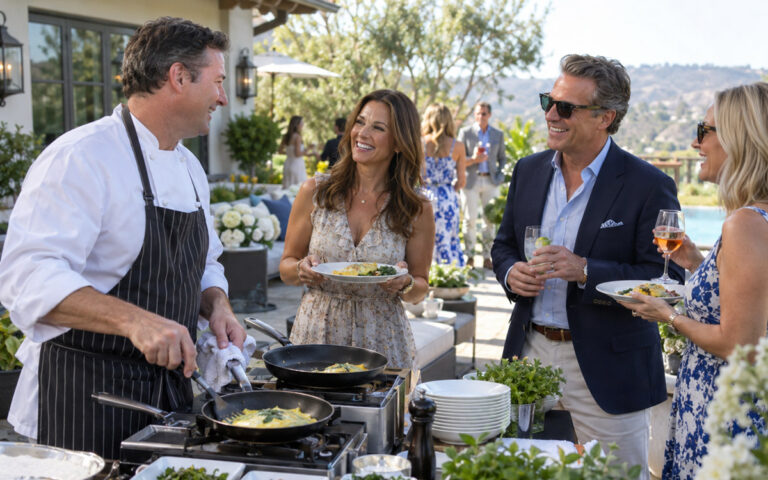
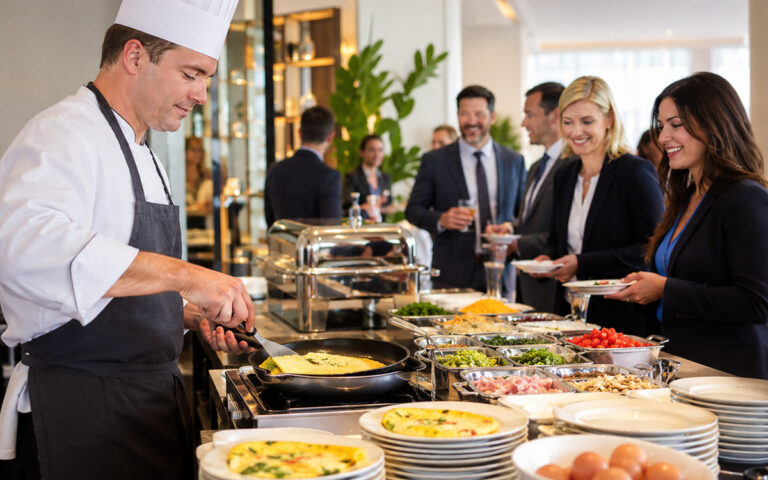
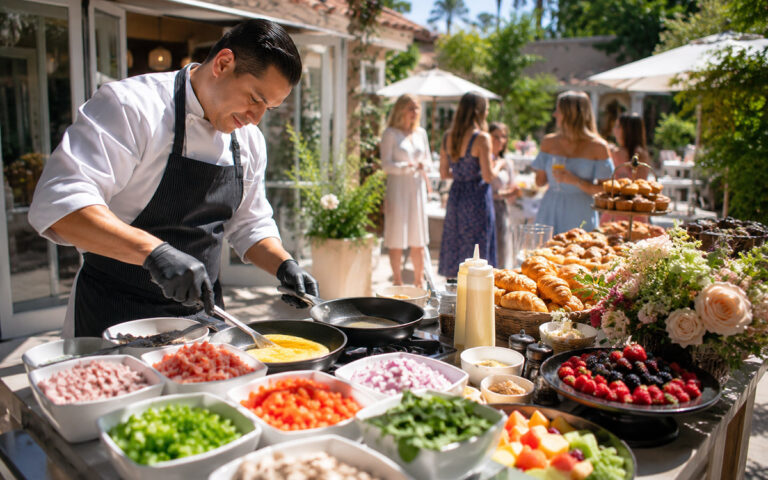
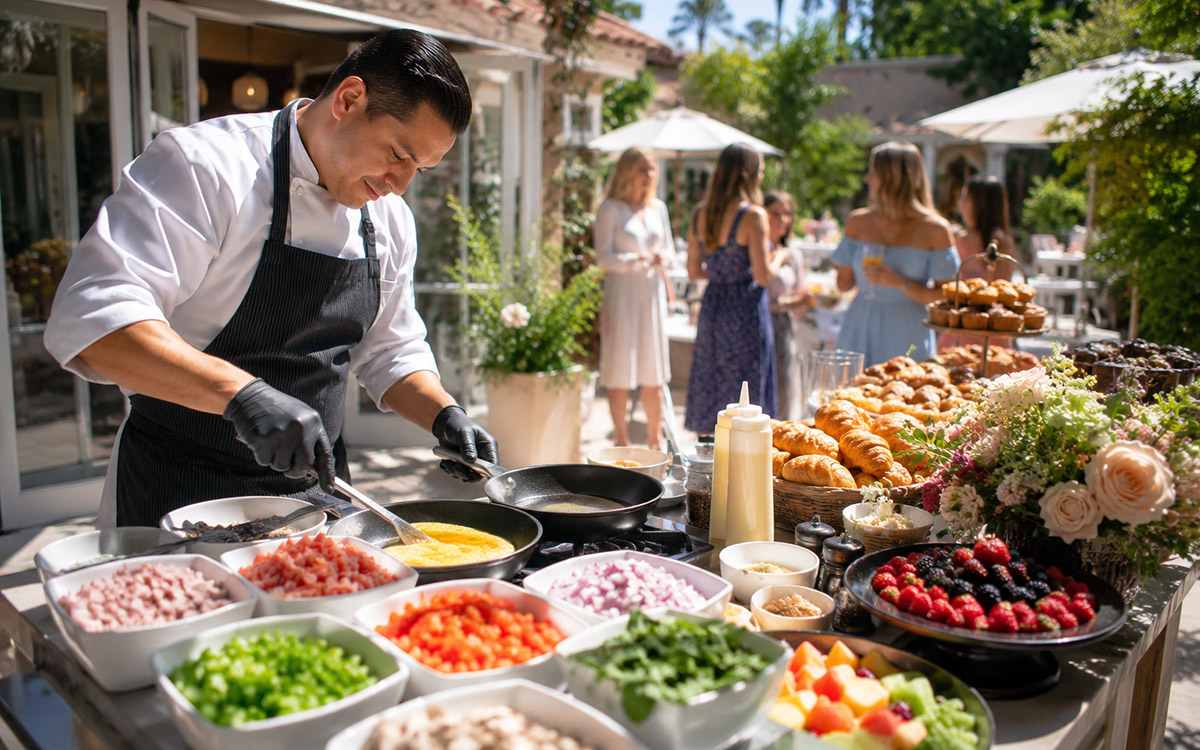
For a brunch event, a made-to-order omelette station can do that particularly well.
The basic concept is simple: guests choose from available fillings and have their omelette prepared fresh. Instead of making several different egg dishes in advance, you allow each person to customize one meal.
That immediately solves several planning problems.
Vegetarian guests can choose vegetables and cheese. Someone who prefers a heartier breakfast can add meat. Guests who like simpler food can order only a few ingredients.
You do not need one tray for meat lovers, another for vegetarians, and another for guests who want something lighter.
The customization is built into the main dish.
That is especially useful as the group gets larger.
With 20 people, you may know everyone’s preferences fairly well. With 50 people, that becomes much less realistic. A flexible main dish reduces the amount of guessing the host has to do.
It also helps keep the food fresh.
Eggs are one of those foods that are noticeably better right after they are cooked. Large trays of scrambled eggs can work, but they may sit for a while as guests move through the buffet.
A made-to-order station allows the main item to be served as guests are ready for it.
When feeding a crowd, the smartest menu is usually not the one with the most dishes. It is the one that gives the most people something they actually want to eat.
Once the main dish is settled, everything else gets easier.
What to Serve for a Brunch of About 20 Guests
A group of around 20 still gives you quite a bit of flexibility.
It is large enough to feel like a real event, but small enough that guests can usually move through the food area without much congestion.
For this size, the menu can stay relatively simple.
A strong lineup might include the following:
- Made-to-order omelettes
- Breakfast potatoes
- Fresh seasonal fruit
- Croissants, muffins, or assorted pastries
- Coffee
- Juice
- Water and sparkling water
- Optional pancakes, waffles, or another sweet item
This gives guests a full meal without overwhelming the setup.
At 20 people, one live cooking area can become a natural gathering point. Guests can order food at different times rather than everyone rushing toward it at once.
If the event is a baby shower or bridal shower, you can also add a separate dessert later without making brunch itself too heavy.
Cake, cookies, cupcakes, or another celebratory sweet can have its own moment after the main meal.
You may also have more room to personalize the menu at this size.
If you know most guests prefer a certain pastry or the guest of honor loves a particular side, it is easier to work those details in.
The biggest mistake with a group of 20 is assuming it is small enough to cook everything yourself without stress.
Twenty omelettes are still 20 individual meals.
If you are also setting tables, arranging flowers, greeting guests, managing drinks, and keeping the event on schedule, cooking can quickly take over the morning.
Think about what you actually want your role to be.
If you want to be standing at the stove, cooking can be part of the fun. If you want to socialize, take photos, and participate in the event, catering may be the better choice.
What Changes When the Guest List Reaches 30
Thirty guests is where brunch planning starts to feel more like event planning.
The menu itself may not need to change dramatically, but the way food is served becomes more important.
At this size, you need to think about lines.
If all 30 people decide to get food at the same moment, even a simple setup can suddenly feel crowded.
One way to avoid that is to make part of the menu immediately available.
Fruit, pastries, beverages, and sides can be placed where guests can help themselves while made-to-order items are being prepared.
This distributes people across the event space.
Someone may grab coffee first. Another guest might take fruit and a pastry while waiting for an omelette. Others may be talking and come back for food a little later.
That staggered approach makes service feel much more relaxed.
For a group of 30, a balanced menu might include:
- Live omelette station
- Breakfast potatoes
- Fresh fruit
- Bread or pastry selection
- One sweet brunch item
- Coffee
- Juice
- Water
- Optional mimosa setup for appropriate events
- A separate dessert if the occasion calls for it
You do not necessarily need more categories than you would for 20 guests.
You simply need more quantity and a better flow.
Serving tables should not block major walkways. Plates and utensils should be easy to find. Drinks should ideally be separated from the main food station because guests will return for beverages several times during the event.
If you have a backyard or patio, spreading the setup across two nearby areas can help.
For example, drinks might be near the seating area while food is served a few steps away.
That small amount of separation can make a noticeable difference.
Feeding 50 Guests Without Making the Menu Unmanageable
At 50 guests, simplicity becomes even more valuable.
The temptation is often to compensate for the larger group by adding more dishes.
Usually, the opposite approach works better.
The more people attending, the more important it is to have a clear, efficient menu.
A live main station, several well-chosen sides, and self-service beverages can provide plenty of food without turning the event into a complicated catering operation.
For 50 guests, consider a menu along these lines:
- Made-to-order omelettes with a streamlined selection of popular fillings
- Breakfast potatoes
- Fresh fruit
- Assorted breads or pastries
- Pancakes or another sweet brunch choice
- Coffee service
- Juice
- Water and sparkling water
- Optional brunch beverages
- Dessert served later, if appropriate
The ingredient selection at the live station should be varied, but it does not need to be endless.
Too many choices can slow service.
A smaller list of reliable favorites is usually more effective.
Vegetables such as spinach, mushrooms, peppers, onions, and tomatoes offer plenty of combinations. A few cheeses and meat choices can complete the selection.
The goal is not to recreate a 40-item restaurant menu.
It is to give everyone enough freedom to build something they like while keeping the station moving.
For a larger event, timing should also be discussed with the caterer.
If the event has a strict schedule, food service may need to open at a specific time. If the gathering is more casual, allowing guests to eat gradually can help reduce congestion.
At 50 guests, seating deserves extra attention too.
Not everyone necessarily needs to sit at a formal dining table, but there should be enough chairs and surfaces for people to comfortably eat.
Standing with a plate for 45 minutes is not a great brunch experience.
Mixing dining tables, patio tables, high-top tables, and lounge seating can work well depending on the venue.
How Much Variety Is Enough?
Hosts often worry that guests will be disappointed if there are not enough options.
In reality, most guests do not need 12 different entrées.
They need a few good choices that cover different preferences.
Think in categories rather than individual dishes.
A complete brunch generally needs the following:
Something savory: omelettes, eggs, or another substantial main item.
Something filling: potatoes, breakfast meats, or another hearty side.
Something fresh: fruit, salad, or vegetables.
Something sweet: pastries, pancakes, waffles, muffins, or dessert.
Something to drink: coffee, juice, water, and any event-specific beverages.
That basic structure works whether you are feeding 20 people or 50.
The quantities change more than the categories.
This is also helpful from a presentation standpoint.
A table with five attractive, well-organized items often looks better than a crowded table with 15 dishes fighting for space.
The food stays easier to identify and easier to replenish.
Plan for Different Appetites Without Overbuying
Not everyone eats the same amount at brunch.
Some guests will have a full omelette, potatoes, fruit, pastries, and another trip back for something sweet.
Others will eat lightly.
Children may take smaller portions. Some guests may arrive having already eaten. Others may treat brunch as their main meal of the day.
That makes exact portion planning difficult.
Rather than trying to predict every plate, think about which foods guests are most likely to eat heavily.
The main entrée should be sufficient for the full guest count.
Staple sides should also be generously planned.
Pastries and sweets can usually be estimated more conservatively because not everyone will take one of every item.
Fresh fruit tends to be popular because it works as a side, starter, or lighter option.
Coffee is another area where running out can be frustrating, particularly for morning events.
If your guest list includes a lot of coffee drinkers, plan accordingly.
Cold beverages should also be easy to replenish, especially during outdoor Orange County events where warmer weather may increase demand.
Your caterer should be able to help estimate quantities based on the number of attendees and the menu being served.
Do Not Forget the People Who Eat Differently
Dietary preferences have become a normal part of event planning.
Vegetarian guests, people avoiding certain meats, and guests with allergies or sensitivities may all be part of the same group.
The solution is not necessarily to create multiple entirely separate menus.
Customization can help.
An omelette station lets guests choose vegetables, cheese, and other ingredients according to their preferences.
Sides can also be selected strategically.
Fresh fruit is widely accessible. Potatoes may work for many guests depending on preparation. Pastries and breads can provide additional options, although ingredients should be verified for anyone with specific restrictions.
Food allergies need more careful planning.
If someone has a severe allergy, that should be communicated with the caterer before the event so preparation and cross-contact concerns can be discussed appropriately.
Do not wait until the morning of the event to mention it.
The more notice a caterer has, the easier it is to determine what can be accommodated safely and realistically.
Good catering is not about trying to predict every preference. It is about creating enough flexibility that most guests can build a meal they are happy with.
Set Up the Food So Guests Are Not All Standing in One Place
A good menu can still feel frustrating if the setup is wrong.
This becomes more noticeable as the guest list grows.
One of the easiest improvements is separating food and beverages.
Coffee should not be directly beside the area where guests are ordering omelettes if you can avoid it.
Why?
Because someone pouring coffee takes longer than you think.
Then they add cream. Then sugar. Then someone else is waiting behind them. Meanwhile, another group is trying to get food from the same space.
Give beverages their own station.
Likewise, plates and utensils should be placed where they are easy to grab without forcing guests to move against the direction of the food line.
If pastries and fruit can be placed on a nearby table, that can help distribute traffic even more.
People should be able to understand the setup almost immediately when they walk into the area.
No one wants to ask, “Where are the plates?” five times during a party.
For outdoor gatherings, think about sun and heat as well.
Place food in shaded areas when appropriate and work with your caterer on the best location for live cooking equipment.
Match the Menu to the Type of Event
Not every brunch needs exactly the same food.
The occasion should influence how you build the menu.
Baby Shower Brunch
Keep the menu balanced and easy to eat while guests move between conversations, games, and gift opening. Fruit, pastries, made-to-order omelettes, potatoes, and nonalcoholic beverages are natural choices.
Bridal Shower Brunch
Presentation may matter a little more. Consider attractive pastries, fresh fruit, a live omelette station, coffee, and a champagne or mimosa option for guests who want it.
Birthday Brunch
You can usually be more playful. Add pancakes, waffles, favorite desserts, or a signature brunch drink depending on the guest of honor.
Post-Wedding Brunch
Guests may arrive at different times, so flexibility is key. Made-to-order food works well because people can eat when they are ready instead of following a strict meal schedule.
Family Gathering
Focus on broad appeal. A customizable main dish is particularly helpful when the guest list includes children, adults, and older relatives.
Corporate or Team Brunch
Keep service straightforward and efficient. Easy access to coffee, fruit, savory food, and seating is usually more important than elaborate décor.
The guest count matters, but the reason everyone is gathering matters too.
Frequently Asked Questions About Brunch for Large Groups
What should I serve for brunch for 20 people?
A simple menu with one customizable main dish, such as omelettes, plus potatoes, fruit, pastries, coffee, juice, and water is usually enough to create a complete brunch.
How much food do I need for 30 brunch guests?
Quantities depend on the menu and type of event, but you should generally plan for every guest to receive a full main serving plus several side options. A caterer can help estimate exact amounts.
What is the easiest brunch to serve to 50 people?
Menus built around a made-to-order main item with self-service sides are often easier to manage than several different cooked entrées. Omelettes, potatoes, fruit, pastries, and beverages can create a complete meal without excessive complexity.
How do I avoid long food lines at a large brunch?
Keep beverages separate, make sides accessible while the main dish is being prepared, and avoid offering an unnecessarily large number of made-to-order choices.
Should I cater brunch for 20 people or cook myself?
That depends on how much of the event you want to spend cooking. Even 20 guests can require significant prep, cooking, cleanup, and timing. Catering allows the host to focus more on the gathering itself.
Make Feeding a Crowd the Easy Part of the Day
Brunch for 20, 30, or 50 guests does not have to mean an enormous menu.
In fact, some of the best large-group brunches are built around a few simple ideas: serve food people genuinely enjoy, give them enough choice, keep the setup easy to navigate, and avoid making the host responsible for cooking everything at once.
A made-to-order omelette station can help achieve all of those goals while bringing a little personality to the meal.
OC Omelette Chef provides live brunch catering for private events throughout Orange County, including baby showers, bridal showers, birthday parties, family gatherings, post-wedding celebrations, and other special occasions.
Whether you are feeding 20 guests in a Newport Beach backyard or planning brunch for 50 at a larger Orange County event, OC Omelette Chef can help make the food service feel fresh, organized, and easy.
Contact OC Omelette Chef to discuss your event date, guest count, location, and brunch catering options.